Thursday, March 29, 2012

A Lesson in Grace

This is not a lesson I’m proud of. But it’s true. And, as Frederich Buechner reminds us in Telling Secrets, we’d all do better as a faith community if we told the truth about ourselves. So, here’s a little truth-telling.

On Saturday I subbed in an English class. The part that I hate to admit: I was holding onto some resentments. Sure, I agreed to help out a colleague, but I wasn’t happy about it. No one’s fault but my own. (I've made my amends). I was also enjoying the Sweet-Tart of resentment at a couple of others colleagues. (The reason doesn't matter. What does is that I need to do Steps 4-10.)

Back to Saturday. The plans indicated that I would be free to do my own work after giving a quiz and talking through some information with the class. I only had an hour of responsibility. The students would self-manage their work for the remaining 3 hours of class.

Well, remember, “If you think you know the plans…”? J’oublie (I forget. A statement in French that I don't forget!).

The quiz took longer than planned. The mini-lecture took longer than planned. Students had more questions than time allowed. I had neglected to make photocopies of the day’s assignment on Friday. So, in the interim when students moved from the classroom to the library, urgently pleaded with the photocopier to comply with my needs. The power shut off in the middle of photocopying, lodging a piece of paper in mid-copy. After the power resumed, it was 10 minutes of trying to problem-solve before I waved the white flag, surrendered to machine, and ran down the hall to where students were trying to figure out my hasty explanations. Did I mention that I had been harboring resentments?

Students started crowding around me with questions about the assignment. And questions about assignments I didn’t know about. And questions about how to proceed with or without assigned partners. And questions about…

I so wanted to take the lid off the grudge sludge and dump it on the floor. But God intervened. Grace intervened. Lessons hard-learned over the last many years whispered truths, including one of the most difficult for me, “Be present. Be in the moment.” I saw the situation for what it was. Students trying to do their work. Students desiring to learn. The only person deserving of my irritation was me. My character defect, willfulness, was eager to lay claim to the moment. It was a decision-point: 


Decide to show grace or to be___ (multiple choice):
A. A_ _
B. B_ _ _ _ 
C. Creep
D. All the above

I don’t take credit for the decision to show grace. It was God, in God’s great mercy and grace. God gave grace to me, so that I, in turn, could show grace to the students. Thank you, Jesus.

The evening before I had listened to two podcasts of Rob Bell preaching at Mars Hill Church. The first was a teaching on Grace from November 6, 2011. The second was a teaching on I John 2, about Love, from May 30, 2011.

Find them. Listen to them. These are the kinds of messages that Christians should be known for—showing love and grace—not anti-abortion, homophobia, “family values,” and “protecting our borders."

Anyway…a few things about grace that prepared me for Saturday (with thanks to Rob Bell):

Grace meets us in the moment when we are most terrified of being found out. Grace confronts us with who we truly are. It’s when we are afraid that our worst secrets, character defects, failures, doubts, hurts, perverse thoughts will be found out, that grace shows up.

Grace shines a light, not to embarrass us, but to say, “Yes, this is true. But now that you admit it, you own the fear, the secret, the failure. You seize its power. It no longer has power over you.” A friend one time reminded me, “Yes, you may not like what's going on. But it is a fact. And once you accept it, you will be able to deal with it and move forward.” And he was right.

Saturday I was afraid that my ugly side, my sick desire for the resentment Sweet-Tart, was going to expose itself. Grace showed up. Shined a mirror and a spotlight in my face. I was able to accept my nasty side and say, “No.”

Grace is a gift. It’s not something we earn. It is true gift. And part of what is so surprising is that the gift comes when we least “deserve” it. It comes when we’re so sure of our weakness and failure and deceit. It came on Saturday when I didn’t deserve it. I was not in a pretty place. But grace showed up.

When grace confronts us it also says, “You’re better than that.” It reminds us that we are made in God’s image. That, as the Hasidic tradition says, we each have a divine spark at our core. On Saturday grace reminded me that I was better than resentment and nastiness; better than A, B, and C. Not better in the sense of superiority, but that I could behave better. Made in the image of God, I had the opportunity to act better than my base instinct.

More profoundly, though, grace has shown up in dark places in my past—places where I have been ashamed. It has shone the light and invited me to step out and be free of the shame.

So, I haven’t said anything about the podcast on love. Maybe that’s for another entry. But, one of the daily readings Saturday morning, before I went to school, was I Corinthians 13:1-13. Thank you, God, for the booster shot I didn’t know I needed.

Nothing matters but love. Nothing. Absolutely NOTHING. Spiritual gifts. Prophesy. Knowledge. Faith. Actions. Self-sacrifice. Tithing. Giving gifts of any sort. Giving up of self. Nothing matters but love. Because love never ends. It is God. It is the Word. It is Jesus. It is Jesus living in us. Prophesies come to an end. Knowledge comes to an end. Actions come to an end. There is something eternal and cosmically connected. It is all love.

I listened to the Grace podcast again this morning. Bell plays the opening of the movie Tree of Life with the following narration:
The nuns taught us there are two ways through life. The Way of Nature and the Way of Grace. We have to choose which one to follow. Grace doesn’t try to please itself. Accepts being slighted, forgotten, disliked. Accepts insults and injuries. Nature only wants to please itself and others to please it too. Likes to lord it over them, to have its own way. It finds reasons to be unhappy when all the world is shining around it and love is smiling through all things. They taught us that no one who ever lives the Way of Grace ever comes to a bad end.

Sounds a bit like I Corinthians 13, doesn’t it?

God, please don’t give up on me. Not yet. I need your grace. Today and always. Help me to live the Way of Grace, to be an instrument of your grace.


And here's another tidbit: Paul bookends each of his epistles (Romans through Philemon) with "Grace and peace to you," and "Grace be with you." I guess Paul thought grace was important.

Monday, March 26, 2012

Gifts

Congo gives me gifts daily. Well, it’s really God working through this place. But it’s in this raw, harsh, dusty place that God graces me with lessons and reminders of a great and extravagant love. God doesn’t give up on me. God, in His and Her infinite love and mercy, graces me, each day with gifts large and small: gentle lessons, saints here on earth, tiny beauties, whispers of joy. And grace.

A recent saints experience: The other day I was walking home from school through our neighborhood. The Beni version of congestion is a cacophony of motos, pedestrians, bicycles with heavy loads, and busy outlining the road. As I rounded the corner to our street, a moto with a woman passenger leaned into me as the driver attempted to outwit another moto speeding up behind. I tumbled over into a woman emptying a bucket of water, and the two motos landed, one of top of the other, against me. As the other taxi drivers parked at the corner dashed over, my first concern was for the drivers’ safety. I have seen a bit of the local street justice. No one was hurt. I was fine. The passenger appeared unfazed. In the melee it appeared that the other drivers were simply trying to assist. 


Out of the crowd emerged Mama Lillian, a sister to Mama Furaha and Mama Odette. She dashed up to me, clasped my arm with a look of concern. I assured her I was OK. No injuries. Just a minor tumble. She put her arm through mine and escorted me down the street to our house. Once inside the gate, she greeted her sisters with great voice and launched into an elaborate, animated, and highly energized retelling of the events, complete with a diagram of the action. How I wish I could have understood all that she said.

Mamas Odette (L), Lillian (C), and Furaha (R)
“So, why do you call this a saint experience”? you ask? Because it’s just one of many examples of how new friends and Congolese sisters and brothers daily appear in my life. Sure, I was fine. I didn’t need any comforting. But Lillian showed up, a kind and exuberant woman concerned for my well-being. Isn’t that what we all should be for each other?

Wednesday, March 21, 2012

Beni truths

A few truths gleaned from daily life in Beni

It’s a good morning every day.  If you’re white and walk anywhere around Beni’s neighborhoods, you’ll be greeted “Goodt mawhrning!” and “How are you?” (with a distinct and sudden rise in the voice at you). All the kids in Beni know the first lesson in the school’s English curriculum, "Everyday greetings." Even if they are too young to be in school. It doesn’t matter whether it’s 6am, 12 noon, or 6pm. Every child between the age of 2 and 12 will holler out from across the road, “Goodt mawhrning! How are you?” Some afternoons I go through my little American tantrum and respond, “Good afternoon,” or “Good evening.” But it’s a futile exercise. The first lesson in any foreign language curriculum is greetings. And besides, what’s so bad about being reminded that regardless of the time of day or my own sassy irritation, that it really is a “Goodt mawhrning” for someone?

Out of peanut butter this morning!
The first piece of bread from the loaf really is the best. Even if it’s bread made that morning and bought in the Matonge Market at noon. 

If you think you know how your day is going to go, you don’t really. At 9am this past Monday I was named “deputy Rector” for a day, or two, or maybe three? With three members of the Management Committee out of the country (doing Ph.D. work) and the Rector out of town for a couple of days, I suddenly found myself with the responsibility of “keeping things going, administratively.” Surprise!

Preparation? No. Previous experience in higher education administration? No. Command of the French language? Definitely, NO. Full understanding of the policies, protocols, and procedures of running a Congolese university? No. Dressed appropriately for the role? No (at least not on Monday—it was “casual dress day” out of my closet, sleeveless shirt and skirt barely below the knees). Prepared to greet a visiting delegation from a Congolese NGO (whose name I still don’t know)? No. “Ja’m appelle Mary? Vous-appelez vous?” Thankfully, Kizito, master of all things PR, carried the conversation. (I wouldn’t blame him for something like, “Yes, please smile and be gracious to Mama Mary. She’s doing the best she can. She’s a pathetic representation of a Rector, but it’s all we’ve got today. Come back next week and you’ll meet the real thing.”)

But the buildings are still standing. No one has resigned. Students have been coming to class. And my UCBC colleagues have rolled with this punch, filled in the gaps of my ignorance, and laughed right along with me.
Best fries in the world
There’s nothing so bad that Gabby’s peanut butter or Mama Furaha’s fries can’t fix. I didn’t grow up in a family that depended on food for comfort. Why is it, though, when I’m stressed, fatigued, frustrated, sad, worried, _____ (yes, fill in the blank), I go to food? And here in Beni, it’s Gabby’s peanut butter, ground by hand from fresh peanuts (locally grown and organic) or Mama’s frites, hot and fresh out of the oil, crispy, golden and oh-so-perfect.


Just one of many
Goats are God’s good humor. How can you not smile at a goat or three or more? These wide-eyed, stiff-legged bumblers are Beni's dandelions. They show up everywhere they belong and don’t. And where yesterday day there were three, tomorrow there will be five new ones. You're supposed to hold them in some disdain and ignore them (or in the case of dandelions, pull them out). But, truth be told, goats are curious little critters in all color combinations--speckled black and white, brown with black markings, grey and dappled. Four-month-old kids butt heads in a show of bravado, reminiscent of high school football players chest-bumping after a touchdown. Does trot down the road, ahead of their petulant, bleating youngsters. Every morning there is the “Marco-Polo” call of kids who have just realized that breakfast just trotted off the compound. And each evening the  "Marco-Polo" game repeats as mama goats head home and their youngsters scramble to keep up.
Baby basil

There is always a surprise in the Beni Cracker-Jack box. And they are there for a reason. To remind me to smile at the daily joys in life and laugh at my own too-serious antics to maintain what? A semblance of order? Control? One from yesterday: A tiny sprout of basil growing in a crack in the pavement. I had dead-headed the basil plants a few days ago and thoughtlessly crumbled the flower heads. And now, a cute sprout takes advantage of Congo's great growing power.

Voila!


Saturday, March 10, 2012

Good Noise Down the Hall

Ryan (L) and Wilfred (R) listen
as students work through sceanrios
It's Saturday. I'm here at school, working away. Communications students are taking exams. An English class is handing in papers. Wilfred Mushagalusha, UCBC's Applied Sciences professor, is hosting a special seminar for his students. All of a sudden there is great rumbling of voices echoing down the hall. It's the sound of students. That healthy, loud buzz of work and discussion, and excitement.

I grab my camera and pop into Wilfred's class. Ryan Metcalf, Macintosh support specialist at Wheaton College (and potential long-term volunteer/International Staff person here at UCBC), is leading a seminar on "Customer Service and Computer Support." As part of the teaching, Ryan has put together scenarios for students to work through in pairs. One person is the user; the other is the customer service/support person. For example:

  • User wants to connect to the Internet, but knows very little about how to do so or how to navigate the browser. The user is frustrated. The customer service/support person has to use common language, demonstrate calmness, and ask questions to deduce the problem, then gently guide the user through the necessary steps....all the while exhibiting good customer service skills.
  • User's computer is running slowly. The customer service/support person needs to problem solve, with the user, who knows nothing about de-fragging or other potential sources of the problem. The solution to the problem is that the computer needs to be de-fragged.

And that's what the noise is about.

What fun to look inside and see students talking excitedly with each other, working through the real-life scenarios drawn from real-life experiences.

Another volunteer here right now, Joost Hartog, said that he's noticed that UCBC faculty and students are different from other Congolese he's met and worked with. "They think. They try to problem-solve. It's a different mentality than I've experienced."

Forget the bad news that comes out of Congo. There is plenty of good news here! There is good teaching. There is good thinking. There is skill-building. There is a desire to serve and strengthen communities. There are sounds of life and learning! The noise and the news are good!

Tuesday, March 6, 2012

A New Owner’s Guide to Beagles. NOT

Part of the vision for UCBC is that students and faculty will be leaders in their fields. They will engage in deep research and imagine and promote new solutions to age-old challenges. They will participate with colleagues across the continent and the globe. They will be 21st Century learners and educators.

There are some gaps we need to fill in order to get there, though.

To begin with, most of our students lack basic knowledge and skills to use a library’s resources, including searching, evaluating, and choosing resources (print and digital). Many faculty lack the knowledge and skills also. The reason? The prevailing system of education in Congo is one based on transmission of information from teacher to student via lecture. Libraries are either non-existent or boxes of cast-off books from well-meaning westerners.

Second, will need to develop our library. Admittedly, the UCBC library is in better shape than many of its peers. We have a designated room where there are books, computers, shelves, and desks. We have two staff designated to serve as librarians, eager to learn and become professional librarians. They need that training.

Calling all Congolese beagle-owners
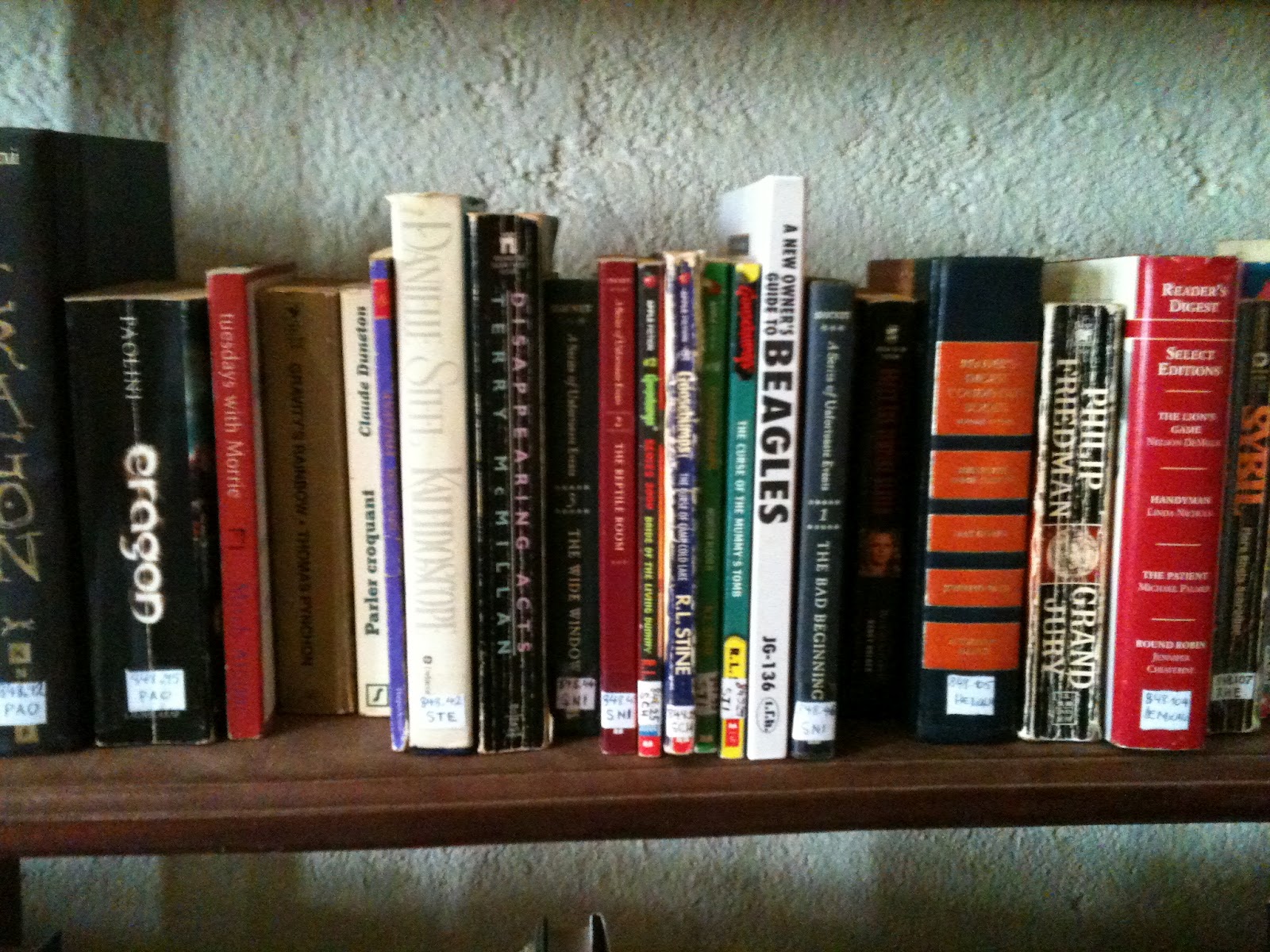
We have books, maybe 1000-1500. The majority are remnants of garage sales. There are probably as many Nora Roberts and Danielle Steele novels as there are books algebra, Congolese history, and sociology texts. A New Owner's Guide to Beagles, Chicken Soup for the Busy Mother, and the Boxcar Children might as well be written in Sanskrit, for all they have to offer our students and faculty. There are books from well-intentioned teachers and academics who have cleared out their own libraries, and some kind donations from a couple of colleges and churches. Thanks to the efforts of some international staff and visitors who want to help build up the library, we also have a handful of new and appropriate titles, including French and English dictionaries!

Our staff record and organize books according to general themes, but the library lacks a cataloguing system.

Then there is the challenge of access to digital resources. Current internet speed is limited—less than 1/20th the speed of the connection speed in the average US household. For students and faculty who rely on one of UCBC’s computers, the window of opportunity to get online is limited to 8:30am-noon and 1:00-4:30, Monday-Friday.

But rather than worry about what we don’t have, we look at what we do have.

First we have students and faculty with a desire to learn and an eagerness to fully engage in the world of academic and intellectual pursuit. One of our library staff, anticipating the arrival of Joost Hartog, an ICT and computer skills instructor, approached me to set up his schedule for the week. He wanted to be sure to block out time to work with Joost and take advantage of his presence. “I want to be a professional. I want to learn how to help our students research and use the computer.”

Lwanzo unpacking new donations
Second, we have designated space for our library. From the beginning, the UCBC leadership committed to developing a library for the university. It was Dr. Kasali, Rector of UCBC, who corrected the Minister of Education about the role of libraries in education. When David went to register UCBC in Kinshasa, the Minister said,  “To have a good university you need land, buildings, students, and teachers.” David responded, “You also need a good library.”

Third, we have new friends and resources who advise us. Engineering Ministries International East Africa (eMi) has is developing a plan for our power needs. The plan will facilitate wise decision-making as to construction and how to build out our power systems in an organized, financially-responsible manner.  We have new friends in the Netherlands who are helping us connect to resources for skill-building for faculty, staff, and students (computer skills, ICT, information literacy, and librarianship training). Chief among them are friends from the Royal Tropical Institute (KIT), Henk van Dam and African Jumanne, and Helen Boelens of the European Network for School Librariesand Information Literacy (ENSIL).

Some of our better titles
Fourth, we have a couple of grant proposals, including one recently submitted to the Zimmer Family Foundation, entitled “EQUIP Project: Creating a Quality University Library for Université Chrétienne Bilingue du Congo (UCBC).” Thanks go to Cullen Rodgers-Gates, Director of US Operations of CI, and Howard Brown, member of the Board of US Operations of CI. A major part of the grant is training for library staff and UCBC faculty in information literacy and ICT skills, so they can then teach their students by integrating this instruction into their curriculum. The grant also provides for librarianship training for our library staff, and improving the library’s resources (e.g., new books appropriate to a university library. Thanks to Henk and Helen for their assistance in writing the proposal. 

Our vision that UCBC students and faculty be fully engaged as 21st Century learners and scholars may be bold. But we are on our way!

Saturday, February 25, 2012

A Reading from Ash Wednesday: Psalm 103


One of readings for Ash Wednesday was Psalm 103, which begins and ends with, "Bless the Lord, O my soul." 

Some thoughts:

“As a father has compassion on his children, so the Lord has compassion on those who fear Him. For he knows how we were made; he remembers that we are dust.” vs. 13-14.
I remembered a photo of my father holding my week-old son. Dad, who was uncomfortable holding babies, fearful he’d hurt or drop them, is deep in thought, prayer, exhaustion, lament, worry, intercession. Carl is sound asleep on his shoulder. What should have been a moment of great joy was one of anxiety, as my parents were reeling from the news that my marriage was disintegrating. The photo captures my dad's concern and compassion. 

This is my picture of God, the father, who “has compassion on his children.” God the father who loves, groans for us, weeps for us, yearns for our well-being.

God forgives, heals, redeems, crowns with love and mercy, satisfies and renews.
There's a progression here in this first part of the Psalm (vs. 1-5). God forgives us for our sins, our acts of disobedience, our behavior toward each other and toward creation. He heals. We need healing from our wounds—wounds that we inflict on others, wounds we inflict on ourselves, wounds we inflict on creation. It is not enough to be forgiven. We must also be healed from the trauma. God redeems. God makes anew, recreates, raises up out of the ashes. Transforms hearts, minds. Anoints us. Takes what was damaged and makes something new—something we couldn’t have imagined. Crowns with love and mercy. Gives us what we need to move forward, to serve again and anew. God gives us the gifts of love and mercy to share with others. Satisfies and renews. What more to say?

God is just and mighty. God is tender and compassionate.
This second section of the Psalm (vs. 6-14) begins with image of the mighty, just and righteous—the God of great power, authority, integrity. The God on high. But it concludes with the image of the tender, compassionate father—the parent who knows the child—knows the circumstances of the child’s conception, birth, and family. The picture is of the father who knows intimately who and why the child is as she is. This father does not judge, but loves and is full of compassion.

But there is something else. Verse 6 says, "The Lord works vindication and justice for all who are oppressed." God is merciful. He vindicates the oppressed. He brings justice. But then the section continues to recount God’s mercy and grace. God does not hold his anger. "The Lord is merciful and gracious, slow to anger and abounding in steadfast love. He will not always accuse, nor will he keep his anger forever. He does not deal with us according to our sins, nor repay us according to our iniquities." This includes the oppressor. 

What a slap upside my self-righteous head! I had been on the cheering squad in verse 6, “Yeah, God! Free the oppressed! Bring justice!” But then the Psalm spins me around and reminds me that once God brings justice, God then “forgives, heals, redeems, crowns, and satisfies.” Yes, God has compassion even on the perpetrator. The oppressor is one of “his children” too.

And to be honest, I perpetrate, oppress, and harm. I may not knowingly enslave another human being. But my buying preferences, my desire for “affordable” (read: “cheap”) goods may fuel a business built on human slavery. The newest piece of technology I buy was most likely assembled in a factory of inhumane working conditions. And how do I harm or oppress people in my daily life? What attitudes do I harbor? What words do I use? God forgives, heals, redeems, crowns, and satisfies me. Again.

Verses 15-18 is a bit distant. It's written in the 3rd person

As if we need to step outside a bit and look more analytically? Speaks about "mere mortals," and "those who fear" God. The section before used 1st person: God "removes our transgressions from us," and "knows how we were made." But now it's 3rd person. We step back a bit. And the writer uses simile. Mortals "are like grass; they flourish like a flower." But God's love is "steadfast." Still love. Still everlasting.

We are called to join the rest of creation--that part of creation that does God's bidding.
At the end, verses 19-22, we come back around a call to bless God. First there is the call to the angels, hosts, ministers—the heavenly bodies ("Bless the Lord, O you his angels, you mighty ones who do his bidding") and creation ("Bless the Lord, all his works, in all places"). This is a great chorus of creation and angels and mighty ones—all that God created during the first 5 days. This is all of creation that follows God’s precepts. It’s we human beings, we mortals who break the laws, disturb the order, insist on our way, who need to be reminded to bless the Lord. Everything else in creation does what God has ordained.

And then the bookend: "Bless the Lord, O my soul." I am part of this wonder that is creation. I am one of many. One of an entire universe. And God knows me.

I'm needing that reminder these days. "Bless the Lord, O my soul." In everything, in every way. For God forgives me, heals me, redeems my life and my choices and my actions, gives me the benefits and gifts of love and mercy, and satisfies me "with good." 

A holy cycle.

Friday, February 17, 2012

Moving

A bit of levity.

The Great Blue Gate
Something interesting passed by our bright blue gate this morning.
The gate is a heavy metal thing that clangs and squeaks and stands about 9-10 feel tall.

While I was enjoying the last cup of coffee, I noticed a chunk of sheet metal passing just above the top line of the gate. It looked like a roof or side of a building.
Movers take a few minutes to rest

Curiosity demanded that I check it out.

Opening the gate, I was surprised to see a group of 8 or 9 men carrying one of Beni's ubiquitous, roadside stores down the road.

Don't like the local customer base? Pick up and move!