Thursday, June 12, 2014

Campus Conversations: Day 3 - English classes

Nono Ilyempo
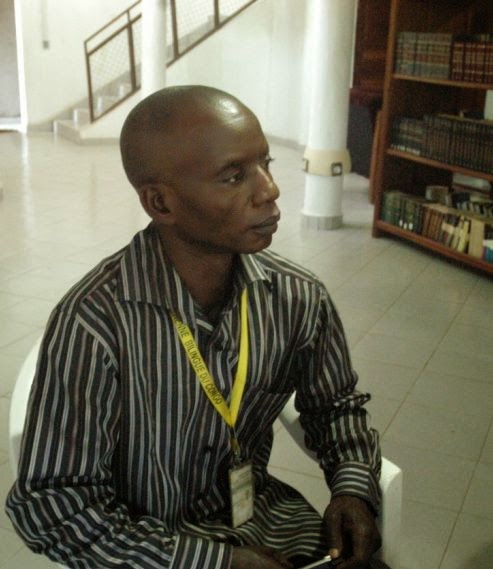
Because UCBC's English classes meet every Wednesday and Saturday, they provided opportunity for all students to engage in conversations with our guest experts and facilitators. Nono Ilyempo and Kambere Kahindo (Kahi) joined the team of experts and facilitators on this day. Nono, a UCBC graduate in communications, hosts a local radio program on environmental matters. Kahi is a local artist with a passion to employ art to cultivate appreciation for the natural world and teach about our responsibility to care for it.
Discussions ranged widely across the six English classes. One class considered personal responsibility towards creation and came to the realization that human welfare and the environment are inextricably linked. In a beginning level class, students developed a list of new English words (e.g., sustainability, pollution, climate change). Their teacher later explained, "The new vocabulary helped students during the week. They had direct experience with new words and phrases to help them in other activities. On Scientific Day [held on Friday], students had could follow the presentations because they knew the vocabulary." Another class discussed the significance of communication to sensitize a community to issues of climate change, pollution, and personal responsibility. 

Virunga Park extends along the border
between DRC and Rwanda (Goma)
and DRC and Uganda (north of Beni)
One of the advanced English classes explored the intersection of population growth, economic development, and protection of natural resources. This particular hot button popped up several times during the week, as conflicts in and around Virunga National Park flare from time to time. Virunga, just outside Beni territory, extends along North Kivu’s east border. The park is Africa’s oldest national park. Many people trace landholdings back before there was a national park. Livelihoods depend on access to land for farming. Conservation and human survival often clash with dire consequences. Modern technology and oil-based economies add to the pressures, as deep-pocket businesses maneuver for drilling rights in the park. With these conflicts just next door, many people in the UCBC community are keenly aware of the challenges. Many have been directly affected.

English classes provided space for teachers to question, ponder, and critique alongside their students. One teacher commented, "It was captivating. I never thought about my responsibility from a biblical perspective." Another stated, "I want to organize a conference in our church. I want the youth to know God beyond the walls of the 'temple.' The Creator is in His nature and sees us in His creation."

New vocabulary words

Tuesday, June 10, 2014

Campus Conversations: Day 2

Tuesday’s activities (May 20) centered around workshops with non-teaching staff. Approximately 25 technical staff (mechanics, carpenters, and ground crew) met with Joel, Elikia, and Ben for sessions on workplace safety, water protection, and managing waste. Faculty and administrative staff often partake of workshops and professional development events, but technical staff have fewer opportunities. One of the strengths of Campus Conversations  was a range of activities to include the entire UCBC community.

Musabao, UCBC driver/mechanic
As educators, we pay attention to “unexpected outcomes”—those nuggets of new knowledge or ideas that pop up and surprise. Several unexpected outcomes popped up from this workshop.

For one thing the grounds crew expressed a desire for a snake guide to help identify venomous snakes. Generally, crew members kill any snakes they encounter. But Elikia and Ben explained the role snakes play in the eco-system, keeping rodents and other “critters” in check.

The team wanted to understand other workplace risks—basic safety matters that generally go unexplained. They were concerned about the dangers of chain-saws, hoes, and machetes, and identified the need to take appropriate steps for protection. Was this creation care? At first I didn't think so. It seemed to me that safe use of tools stands in a category separate from environmental stewardship. But, if creation care is about caring for all creation, then providing physical protection for people who work out in nature is no less important than addressing the human consequences of climate change (e.g., extreme weather changes, flooding, typhoons).
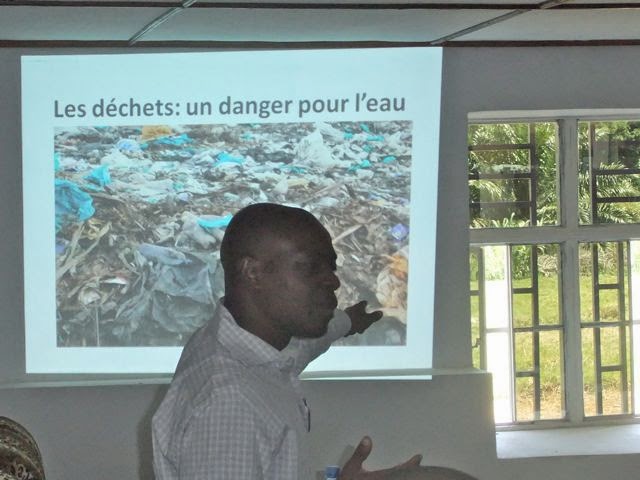
Joel discusses water pollution
The crew expressed interest in serving as ambassadors and managing  the campus as a teaching tool. They discussed the possibility of leading a native tree planting project and making labels to name and describe tree species and their use for medicinal, nutritional, or other purposes.

In the afternoon, Ben, Rachel, and Joel met with administrative and support/office staff to discuss responsible use of resources in the office workplace. Among the topics was how to better manage printing and copying needs to reduce waste and save money. The group also discussed the reality that sometimes doing the right thing is cost efficient. Sometimes it costs more. Environmental stewardship enjoys no respite from the tension between expediency and ethics.

Management of electronic waste also generated discussion. The group did not identify action steps; however, what did bubble up is that there are some students and faculty on campus interested in figuring out solutions. The group did not develop concrete action plans on this matter, but at least that had conversations

Monday, June 9, 2014

Campus Conversations: Day 1

After six months of preparation and planning, Creation Care: Campus Conversations launched officially with a special chapel on Monday, May 19. Special for several reasons.

Rachel, Elikia, Joel, Ben (L to R)
First, the entire UCBC community joined together. Usually, only students and faculty attend Monday and Friday chapel services. The technical staffs of grounds crew, mechanics, and construction workers have their own prayer and Bible study time on Saturdays. Second, chapel was conducted in Swahili and English, rather than French and English. Third, we had special guests in attendance. In addition to Jay and Jessica Shewan (brother and sister-in-law of one of our international staff), four experts and practitioners in environmental stewardship rounded out the gathering.  Joel Vwira Tembo (Goma Business Services), Elikia Amani Zahinda (Congolese Foresters Network), Rachel Lamb (Young Evangelicals for Climate Action) and Ben Lowe (Evangelical Environmental Network and Young Evangelicals for Climate Action) had come to join us as teachers and facilitators for the week. 

Honoré set the stage for the week, welcoming our special guests and also UCBC’s technical crew. He reminded us all that we are ONE community. Each of us has a role, a job, a set of responsibilities, talents and gifts. None of these outshines any other. We are all members of one body. To be honest, that message was one that I had hoped would be communicated. UCBC requires students to do manual labor each week. Work Program is one way we teach and remind students that manual labor is a responsibility and its own reward. A university diploma is not “ticket out.” It is a “commitment to.” It’s a commitment to honor and respect those who labor physically and a commitment to share in the physical burdens of all who make up our communities.

Ben teaches, Katsongo interprets
It's too easy to get caught up in one's own concerns and spin daily activities in our own sphere. I know I regularly fail to recognize those whose labors, whether intellectual or physical, spin at the outer edges of my own.
Research and agribusiness meeting
Elikia Amani Zahinda (L) and
Joel Vwira Tembo (R) flank Jon Shaw

After singing, introductions, and an outline of the week's activities, Honoré welcomed Ben to the podium. Katsongo, Theology Faculty Coordinator, translated as Ben gave a brief teaching entitled, "Creation Care: Discipleship and Faithful Witness." 
English teachers
(L to R) Mashauri,  John, Josias

In the afternoon, Ben, Rachel, Elikia, and Joel met with the team heading up UCBC’s initiative to strengthen research capacity through an examination of agri-business education. The purpose of the meeting was to establish professional connections and push the conversation about agri-business, sustainability, environmental stewardship, and agro-forestry. Afterwards, the visiting team and English teachers gathered at my house for afternoon tea.


(L to R) Joel, Rachel, Ben,
Kinangani (director of RTB), and me

Sunday, June 1, 2014

A day of rest

Quiet morning with a bit of fog from last night’s rain. After church I met two students, then came home to enjoy a quiet day of rest. A little writing. A little reading. A little French studying.

Collected orange and yellow cosmos from the garden to set in a jar of water.
Watched the sun dance in the curtains.
Talked to my kids on the phone.

Now Mdogo (father of the kittens) purrs contentedly beside me.


A power surge fried my laptop power cable this evening.

I refuse to let that inconvenience and the required replacement purchase dim the day.

Monday, March 17, 2014

St. Patrick's Breastplate

Today's is St. Patrick's Day. I'll wear something green in solidarity with my Irish friends. I hope they'll forgive me for allowing myself to be captivated by a hymn rather than a pub song, however. It's the hymn attributed to St. Patrick, I bind unto myself today (see The Hymnal 1982, #370)

The hymn speaks of God's expansive presence and all-embracing love.

Thanks be to God.

Enjoy an arrangement sung by St. Peter's Singers of Leeds.

1 I bind unto myself today
the strong name of the Trinity
by invocation of the same,
the Three in One and One in Three.
2 I bind this day to me forever,
by power of faith, Christ’s incarnation,
his baptism in the Jordan river,
his death on cross for my salvation,
his bursting from the spiced tomb,
his riding up the heavenly way,
his coming at the day of doom,
I bind unto myself today.
3 I bind unto myself today
the virtues of the starlit heaven,
the glorious sun’s life-giving ray,
the whiteness of the moon at even,
the flashing of the lightning free,
the whirling wind’s tempestuous shocks,
the stable earth, the deep salt sea
around the old eternal rocks.
4 I bind unto myself today
the power of God to hold and lead,
God’s eye to watch, God’s might to stay,
God’s ear to hearken to my need,
the wisdom of my God to teach,
God’s hand to guide, God’s shield to ward,
the word of God to give me speech,
God’s heavenly host to be my guard.
5 Christ be with me, Christ within me,
Christ behind me, Christ before me,
Christ beside me, Christ to win me,
Christ to comfort and restore me.
Christ beneath me, Christ above me,
Christ in quiet, Christ in danger,
Christ in hearts of all that love me,
Christ in mouth of friend and stranger.
6 I bind unto myself the name,
the strong name of the Trinity
by invocation of the same,
the Three in One and One in Three,
of whom all nature has creation,
eternal Father, Spirit, Word.
Praise to the Lord of my salvation;
salvation is of Christ the Lord!


Monday, February 3, 2014

Women's Stories

I've been "wearing" three different lenses when I read the Bible: the lens of women’s voices and experiences, the lens of justice and mercy, and the lens of care and responsibility for the created world or the world of “nature.” Reading with these lenses reveals stories and descriptions previously hidden in the shadows of neglect. The lenses of women's experiences have opened up three stories recently (italics are mine).

From the conclusion to the book of Job (42: 12-15)

So the Lord blessed Job in the second half of his life even more than in the beginning. For now he had 14,000 sheep, 6,000 camels, 1,000 teams of oxen, and 1,000 female donkeys. He also gave Job seven more sons and three more daughters. He named his first daughter Jemimah, the second Keziah, and the third Keren-happuch. In all the land no women were as lovely as the daughters of Job. And their father put them into his will along with their brothers.
I’m no Bible or ancient history scholar, but it seems significant that (1) Job’s daughters are named (but the sons are not); and (2) there is a statement that Job put them into his will. From what I do know about the ancient world, women were accorded no status. They were property. They were handed over to their husband’s brother if their own husband died. But here, in Job, we see the beginning of putting things right—putting things back in place as they were in Eden before The Fall, when Adam and Eve were equal, of one, with shared gifts and responsibilities. These women are named in the scripture. And Job acknowledged their worth as human beings, equal to their brothers, and put them into his will.

So I rejoice with Job’s daughters. They have names. They are people. They receive protection and property. Certainly there is much more in this passage. But I rejoice in this different order, a different understanding of women, of one’s daughters.

From the story of the birth of Moses (Exodus 2:1-10)

(v. 1-3) About this time, a man and woman from the tribe of Levi got married. The woman became pregnant and gave birth to a son. She saw that he was a special baby and kept him hidden for three months. But when she could no longer hide him, she got a basket made of papyrus reeds and waterproofed it with tar and pitch…  
[The sister keeps watch over the baby in the reeds. Pharoah’s daughter finds the baby, and when the sister offers to “find one of the Hebrew women to nurse the baby,” the princess agrees.] 
(v. 9-10) “Take this baby and nurse him for me,” the princess told the baby’ mother. “I will pay you for your help.” So the woman took her baby home and nursed him. Later, when the boy was older, his mother brought him back to Pharoah’s daughter, who adopted him as her own son. The princess named him Moses, for she explained, “I lifted him out of the water.”
Moses’ mother saw that he was a special baby. A small sentence. But a profound one. This mother, who has no name in the story, recognizes that her infant is special. Did God speak to her? What words did he whisper into her heart that she knew she had to take action to protect her child, not only because he was her son, but also because “he was a special baby.” And what courage she exhibited. This Pharoah knew nothing about Jacob and how he saved Egypt from ruin during the time of famine some 300 years before. Under this brutal Pharoah, the Israelites suffered “crushing labor” and the murder of their infant sons. Who knows what Moses’ mother risked by devising a plan to protect her child?

But then the greater courage and the deep pain. After caring for her son for some months, perhaps a year or more, nursing him, loving him, tending to his needs, she hands him over to the tyrant’s daughter.

What did she feel? What anguish must she have suffered? For how many days and nights did she weep? Did she know solace at any moment?  Did God say anything to her? Did God console her? Give her any relief from a life of cruel slavery? We don’t know. That part of the story has been lost, just as her name was lost.

I mourn for Moses’ mother, for her loss and pain. I also lift her up and celebrate her as a woman of courage and faithfulness.

Moses, Zipporah, and their family travel to Egypt from Midian (Exodus 4:24-26)

On the way to Egypt, at a place where Moses and his family had stopped for the night, the Lord confronted him and was about to kill him. But Moses’ wife, Zipporah, took a flint knife and circumcised her son. She touched his feet with the foreskin and said, “Now you are a bridegroom of blood to me.”…After that the Lord left him alone.

A woman of action. A woman of agency. That is Zipporah. I don’t remember this story. In all my years of Sunday school and church, prayer meetings and Bible studies, I have never heard anyone talk about Zipporah and how she was responsible for saving Moses from God’s anger. And God was probably pretty ticked at Moses. After all, Moses had been protesting and pleading with God to excuse him from going back to Egypt (at least 5 times between Exodus 3:11 and 4:14). Zipporah recognized that her husband had been whining and acting the coward. She took action to carry out the family’s part in the covenant and circumcise the son.

It's a story tucked away, brushed over, and neglected. Yet it’s a story of courage, a story of agency and action, and a story of responsibility.

How many other stories have been hidden in the shadow of neglect? I look for them and share them with the women with whom I work and live here in Beni--women who have their own magnificent stories.

Sunday, February 2, 2014

Surprise Gift

Yesterday morning there was a call from the hallway, “Mama Mary.” I opened my bedroom door to see Maou, our guard, standing in the hall. “Mama Furaha apeleka huyu” (“Mama Furaha sent this.”). He held out a small, thin plastic bag, the ubiquitous shopping sack of Beni. Inside the bag were four handfuls of freshly cut, tender basil leaves. They glistened in the darkness and smelled glorious. 

“Mama Furaha hapa?” (“Mama Furaha’s here?”).

“Hapana. Watoto alipeleka” (“No, the children brought this.”).

I’ve known Mama Furaha since 2010. Until last summer, she served as cook at the international staff house, a role she had for four years. Mama Furaha makes the most succulent samosas and the crispiest frites. She pays attention to what people like and accommodates (and surprises) with her culinary skills and a charcoal stove. She is a consummate teacher, whether she is showing how to make samosas or coaching Swahili in a gentle, encouraging manner.

Mama Furaha lives out her name in spite of hardships. Health issues, a husband who struggles to maintain a job and sobriety, and raising three grandchildren do not dampen Mama Furaha’s spirit. Furaha means joy or happiness.

Mama Furaha knows that I like basil and enjoy a salad of it with chopped tomatoes, fresh spinach (if it’s available), avocado, and a little onion. She also knows that we don’t have basil growing at Bethel House, the guesthouse where I’ve been living for the past several months. Her gift yesterday was an expression of love. Last evening, while relishing my salad, I offered thanks for Mama Furaha and her loving kindness.

This afternoon I’ll visit her to say,“Thank you, dear friend,” and ask her to join me when I move to my own home here in Beni, in two weeks. I’m hoping she will be willing to help manage the house, cook, and continue as my Swahili coach. I’m hoping she will continue to grace me with the joy of her spirit.