Sitting here at Columbus airport ready for first leg of the trip to Beni, DRC.
Short skip to Detroit, then on to Amsterdam, Entebbe (and an overnight at the Central Inn). On Saturday, a flight on TMK from Entebbe to Beni (or maybe Butembo, via Bunia).
I am at that place of "relaxed alertness," where learning occurs, where there is "low threat and high challenge." (Caine and Caine)
Thursday, October 8, 2009


Thursday, October 1, 2009
Thoughts on "The Future of Teaching"
One of the messages in my inbox this morning came from the Center for Teaching Quality (CTQ). The item announced the inauguration of TeacherSolutions 2030--an initiative to explore and help shape teaching as a "student-centered profession." There were references and links to the most recent blog posts at the Future of Teaching blog. Two that caught my eye were "Do You See What I See?" and "Medicine and Education."
"Do You See What I See?" reminds us that we must continue to fight for equity in education--equity in all aspects and across all borders. That took me to the question: What if in our attention to public education in the U.S. we also paid attention to, advocated for, and worked to ensure educational access for girls and women in cultures that consider females as property only; OR comprehensive primary education for ALL children across this globe--goal #2 of the MDGs? The current U.S. administration reminds us to think about and act on behalf of the common good. And isn't the common good wider than U.S. borders?
"Medicine and Education" picks up on the theme of advocating for what's right. All of us, not just educators, must be vigilant to speak out for quality, for education and for allocating ever-diminishing resources (and they've been diminishing since the beginning of time, haven't they??) for education. I, of course, jump to the larger discussion, and think, "Yes, and again...let's look beyond our borders. Let's look to the common good and strive to meet the needs of all who are denied voice and power. A lofty and unrealistic goal? Yes. But I suspect that the early advocates for civil rights in the U.S., the visionaries who imagined democracy in India, and William Wilberforce and William Lloyd Garrison were criticized for their lofty visions and unreachable goals.
"Do You See What I See?" reminds us that we must continue to fight for equity in education--equity in all aspects and across all borders. That took me to the question: What if in our attention to public education in the U.S. we also paid attention to, advocated for, and worked to ensure educational access for girls and women in cultures that consider females as property only; OR comprehensive primary education for ALL children across this globe--goal #2 of the MDGs? The current U.S. administration reminds us to think about and act on behalf of the common good. And isn't the common good wider than U.S. borders?
"Medicine and Education" picks up on the theme of advocating for what's right. All of us, not just educators, must be vigilant to speak out for quality, for education and for allocating ever-diminishing resources (and they've been diminishing since the beginning of time, haven't they??) for education. I, of course, jump to the larger discussion, and think, "Yes, and again...let's look beyond our borders. Let's look to the common good and strive to meet the needs of all who are denied voice and power. A lofty and unrealistic goal? Yes. But I suspect that the early advocates for civil rights in the U.S., the visionaries who imagined democracy in India, and William Wilberforce and William Lloyd Garrison were criticized for their lofty visions and unreachable goals.
Tuesday, August 18, 2009
The Edible Schoolyard
Somewhere in the email and blogposting universe, I tripped over a link to an Edutopia story about the Edible Schoolyard.
Martin Luther King Middle School, in Berkley, CA, has a one-acre garden where students grow food, raise chickens, learn about soil, pollination, water cycle, and all the other good stuff that is part of life. They also learn the value of physical labor and work ethic. I imagine they experience and learn about true team work, collaboration, planning, disappointments, successes, and that other stuff that is part of life.
In an era of shrinking natural resources and expanding midriffs, low nutritional values and high cholesterol, and as the rate of type 2 diabetes skyrockets among our youth, and especially among youth in poor communities, it is urgent that kids experience and learn about healthy eating.
Seems to me that the Edible Schoolyard could provide the framework for a rich, integrated curriculum with depth and substance (no pun intended). Also could open the door to the broader topic of sustainability, including green practices, stewardship, xeriscape, and energy conservation.
NB: This is cross-posted to MSP2
Martin Luther King Middle School, in Berkley, CA, has a one-acre garden where students grow food, raise chickens, learn about soil, pollination, water cycle, and all the other good stuff that is part of life. They also learn the value of physical labor and work ethic. I imagine they experience and learn about true team work, collaboration, planning, disappointments, successes, and that other stuff that is part of life.
In an era of shrinking natural resources and expanding midriffs, low nutritional values and high cholesterol, and as the rate of type 2 diabetes skyrockets among our youth, and especially among youth in poor communities, it is urgent that kids experience and learn about healthy eating.
Seems to me that the Edible Schoolyard could provide the framework for a rich, integrated curriculum with depth and substance (no pun intended). Also could open the door to the broader topic of sustainability, including green practices, stewardship, xeriscape, and energy conservation.
NB: This is cross-posted to MSP2
Monday, July 6, 2009
The first harvest

Yesterday Sarah and Grace (two of our younger gardeners) harvested the first of our veggies: a handful of radishes and one stowaway onion. A small and humble harvest. But it's our first offering. Jesus asks us to give what we have. Our responsibility is to do the work. God's responsibility is to bless and use it.
The loaves and fishes the little boy gave to Jesus were all that the child had (John 6:9). But Jesus took, blessed, and multiplied that small gift. Through a boy's lunch of 5 loaves and 2 fishes, several thousand people were fed (women, children, and 5000 men - John. 6:10).
I don't know what God will do with a handful of radishes. Maybe nothing that I will see. But it may be more than any one of us can imagine.
P.S. By the way, why does only John mention the boy?
Sunday, May 24, 2009

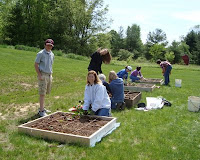 So, in the midst of searching for a job, networking for career change, and seeking the place where my "deep gladness" meets "the world's deep hunger" (Frederick Buechner, Wishful Thinking: A Thelogical ABC), I've come to understand that I need to be present and responsive to whatever God puts in front of me. And for now, for this next, undefined period of time, I am to rest and do, rather than anguish and seek.
One of the things God has put in front of me is to help manage a garden to raise food to help feed local people in need. I wasn't looking to manage a garden or organize a group of parishoners. But I do care about--
- organic, local food production
- stewardship of resources
- social justice
- meeting the needs of people suffering from poverty and hunger
- engaging in conversation with other Christians about living out Matthew 25 and Micah 6:8
At first the plan was to plow and plant. But attempts to dig into the plot to gather soil samples met with an interesting obstacle: wire mesh buried 3" below the surface of the ground, in the area where the garden was to be planted. This 200' x 50' bed of wire mesh is, apparently, an ill-devised and unncessary precaution to support emergency vehicles from getting stuck in the turf.
So...next option: square foot gardening (gardening in boxes on top of the turf). But this entry isn't about SFG. It's about taking hold of a opportunity and being open to learning.
First of all, I'm learning that there are plenty of folks who practice "reuse, reduce, and recycle." And it's fun to learn from each other. For ground cover over the turf, Tim and I used wool and cotton moving blankets that Tim's employer, Trader Joes, uses to wrap flowers and produce. The wood was "gleaned" from construction sites and a family farm. Seeds came from our respective home collections. When it came time to make markers for our Square Foot plots, Tim ripped up lumber from his collection. It's been fun to hear some of the crew wonder about using rain barrels to harvest rain water to water the garden and composting grass clippings and Sunday coffee hous contributions.

Second, people really do like to get out, get their hands dirty, and make something happen. About 10 adults and children helped plant our four boxes with onions, tomatoes, beets, carrots, and peppers. We're using an online calendar to sign up for watering and tending, and so far, everyone's
 following through.
Third, as I already knew, I'm not so good with "follow through, " and so it's wonderful to share this project with others!
But finally, the garden is reminding me about "walking humbly." I admit it. I tend to judgmentalism. I may not speak my criticisms, but I think them: "How could she even think..., Why would anyone want to..., Just imagine all the hungry people that so-and-so could feed if they didn't spend all that money on..." (A friend once pointed out that I'm not responsible for the initial thought, but I am responsible for the second. Mercy and a chance to make amends at work!).
The garden reminds me that what I see isn't all there is. The beets are sprouting in the garden. You can see the ruby and forest green leaves push through the dirt. You can't see the seed sprouting and splitting, sending its roots into the soil. The garden also reminds me that we're always planting seeds in our own actions and words (this is something my mother used to remind me). Whatever I desire to nurture in others, I must demonstrate in myself--kindness towards others, selflessness. sacrificial giving. The garden also reminds me that relationships take time and nuture. We can't just plant and walk away, assuming that all will be well. We have to tend, water, weed, protect from bugs and critters. So it is with the people and relationships in our lives.
Saturday, May 16, 2009
Green for All and M2EP
On Monday of M2EP (April 27, 2009), three advisors to the White House spoke to the gathering about the Administration's efforts to reduce poverty.
Jones used metaphors of infants, teenagers, bubblegum to make link between energy and green economy and anti-poverty action.
Infants: Infants are delicate but sophisticated bodies, "finely tuned" and "prepared for life." When a baby's temperature rises 1 degree, we notice. When a baby's temperature rises 2 degrees, we become concerned. When a baby's temperature rises 3 degrees, we start to take action. Earth is also a highly developed system, "engineered for life." It's temperature is rising.
Teenagers: Teenagers "tell you they love you. But you find no evidence of that in their behavior." You can't say you love someone, then act disrespectfully (e.g., ignoring house rules, yelling, disrespecting personal property of the other/family). Or, in Jones' words, "You cannot love the creator and disrespect the creation." Words and actions tell the truth. But, as inhabitants of the planet, we seem to have done just that.
Bubblegum: Imagine walking down a city street, popping a piece of bubblegum in your mouth,
then tossing the wrapper on the ground. Also imagine a local police officer right behind you who stops and reminds you that there is a fine for littering (Jones did a delightful job of embellishing the scene with hyperbolic humor). As a good citizen, you concur and agree to pay the fine. The point: anyone who pollutes should pay either fine or fee. You have to pay to pollute.
The summary then:
- Martha Coven, Director of the White House Office of Mobility and Opportunity
- Josh Dubois, Director of the White House Office of Faith-Based and Neighborhood Partnerships
- Van Jones, Special Adviser for Green Jobs, Enterprise, and Innovation at the Council on Environmental Quality, and founder of Green for All
Jones used metaphors of infants, teenagers, bubblegum to make link between energy and green economy and anti-poverty action.
Infants: Infants are delicate but sophisticated bodies, "finely tuned" and "prepared for life." When a baby's temperature rises 1 degree, we notice. When a baby's temperature rises 2 degrees, we become concerned. When a baby's temperature rises 3 degrees, we start to take action. Earth is also a highly developed system, "engineered for life." It's temperature is rising.
Teenagers: Teenagers "tell you they love you. But you find no evidence of that in their behavior." You can't say you love someone, then act disrespectfully (e.g., ignoring house rules, yelling, disrespecting personal property of the other/family). Or, in Jones' words, "You cannot love the creator and disrespect the creation." Words and actions tell the truth. But, as inhabitants of the planet, we seem to have done just that.
Bubblegum: Imagine walking down a city street, popping a piece of bubblegum in your mouth,
then tossing the wrapper on the ground. Also imagine a local police officer right behind you who stops and reminds you that there is a fine for littering (Jones did a delightful job of embellishing the scene with hyperbolic humor). As a good citizen, you concur and agree to pay the fine. The point: anyone who pollutes should pay either fine or fee. You have to pay to pollute.
The summary then:
- Treat the globe like an infant.
- Act like an adult, not a teenager. Don't disrespect the creator by disrespecting the creation.
- If you want to pollute, you have to pay--either fee or fine.
Saturday, May 2, 2009
M2EP-"Belief in spite of the evidence"
"Hope is belief in spite of the evidence; then watching the evidence change." The quotation may not be exact, but this the the gist of it. Jim Wallis reminded the several hundred gathered at Shiloh Baptist Church last Sunday night, April 26, at the opening worship service of the Mobilization 2 End Poverty campaign . That notion wove through the plenary sessions and worship services during the 3-1/2 days. You couldn't miss it, not with living reminders of the civil rights struggles (Rep. John Lewis, Dr. Vincent Harding, and John Perkins) or present-day examples of hoping and working for change in spite of the evidence, like Alexie Torres Fleming, founder of Youth Ministries for Peace and Justice, who organized her neighborhood against the drug lords of her community, in spite of death threats, arson, and fear; and Rachel Anderson and Lisa Sharon Harper, who, along with other believers, formed the Boston Faith and Justice Network (working, among other things, to make Boston a "Fair Trade City") and the New York Faith and Justice Network, respectively.
There were the historical reminders that people of faith and people with hope have fought against fears and systems to change what others thought could never be changed. Richard Stearns, of World Vision, recounted the story of the British abolitionists who fought to abolish the trans-Atlantic slave trade--a system that fueled an empire and an economy.
And of course, throughout the entire M2EP, we were reminded about our biblical call to abolish injustice and bring about change in spite of the cost, in spite of the odds, in spite of what seems realistic.
But back to the statement, "Hope is belief in spite of the evidence, then watching the evidence change." What if we lived that way? What if Christians, people who profess belief, profess faith in the Almighty (think about that word!) really lived out life that way? I must admit, while I think I have strong faith about my personal, private, and family life, I have meager faith when it comes to the kingdom of God here on earth. Now. Eliminate poverty? Eliminate starvation? Make sure every human being has clean water to drink? Eliminate slavery? Stop the illegal trafficking of over 1 million children each year? The Millenium Development Goals?
My faith has been too small. My hope too weak. I have fallen into the trap of rationalism and reality of the day. "No one has ever...." "How can you think that...when the deficit is...$$?" I don't know. I don't have rational answers. But I believe in an Almighty God, the power of the Holy Spirit, and the love of Jesus. And there are plenty of reminders of God's greatness "in spite of evidence." Esther. Ruth and Naomi. David, the shepherd. Mary and Martha and the friends of a dead Lazarus. Daniel surviving a lion.
My faith may be small; but I'm trying to grow it.

There were the historical reminders that people of faith and people with hope have fought against fears and systems to change what others thought could never be changed. Richard Stearns, of World Vision, recounted the story of the British abolitionists who fought to abolish the trans-Atlantic slave trade--a system that fueled an empire and an economy.
And of course, throughout the entire M2EP, we were reminded about our biblical call to abolish injustice and bring about change in spite of the cost, in spite of the odds, in spite of what seems realistic.
But back to the statement, "Hope is belief in spite of the evidence, then watching the evidence change." What if we lived that way? What if Christians, people who profess belief, profess faith in the Almighty (think about that word!) really lived out life that way? I must admit, while I think I have strong faith about my personal, private, and family life, I have meager faith when it comes to the kingdom of God here on earth. Now. Eliminate poverty? Eliminate starvation? Make sure every human being has clean water to drink? Eliminate slavery? Stop the illegal trafficking of over 1 million children each year? The Millenium Development Goals?
My faith has been too small. My hope too weak. I have fallen into the trap of rationalism and reality of the day. "No one has ever...." "How can you think that...when the deficit is...$$?" I don't know. I don't have rational answers. But I believe in an Almighty God, the power of the Holy Spirit, and the love of Jesus. And there are plenty of reminders of God's greatness "in spite of evidence." Esther. Ruth and Naomi. David, the shepherd. Mary and Martha and the friends of a dead Lazarus. Daniel surviving a lion.
My faith may be small; but I'm trying to grow it.

Subscribe to:
Posts (Atom)

 Posts
Posts

